The book. Now available.
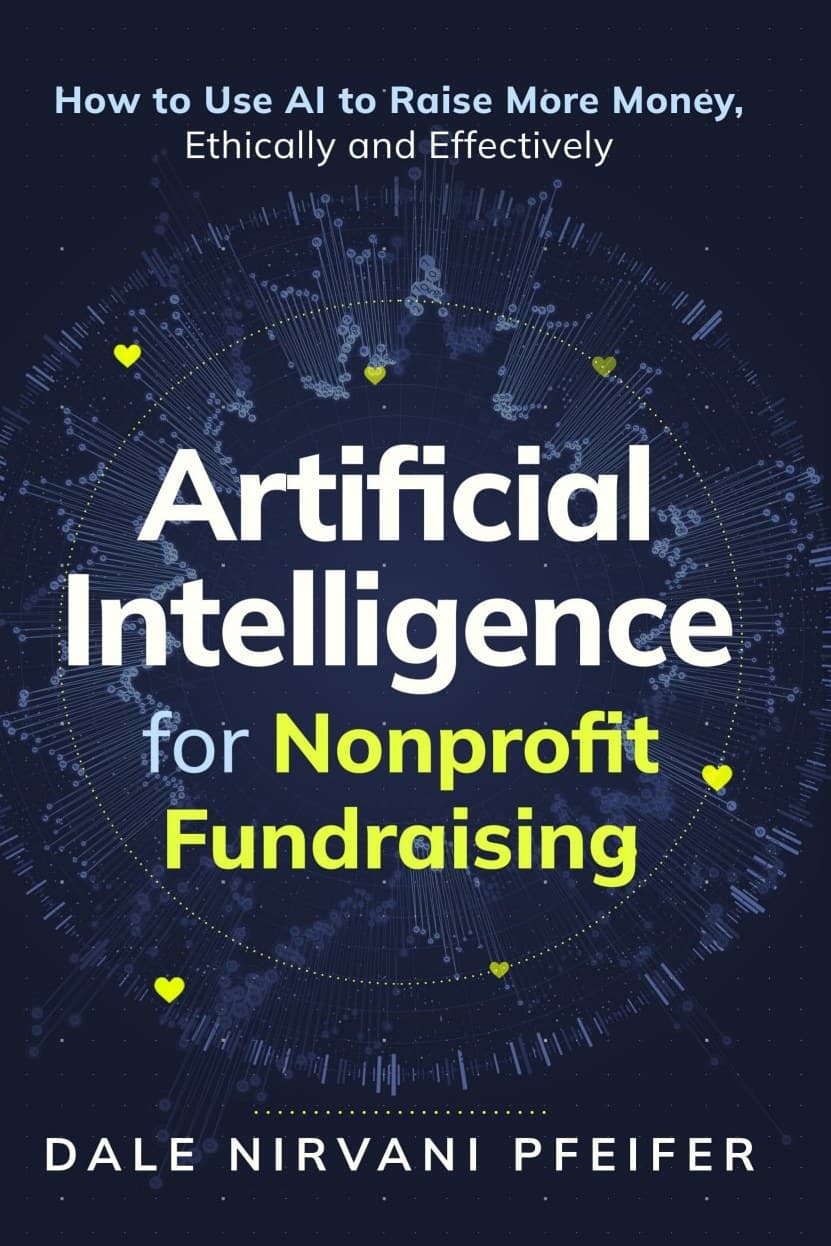
Artificial Intelligencefor Nonprofit Fundraising
Raise More Money, Ethically and Effectively.
Three parts. Fifteen chapters. Eleven named case studies. A working playbook for nonprofit leaders who want clear judgment in the age of AI, not faster versions of the wrong work.
About the book
A practical book for a moment that does not feel practical.
AI capability is racing ahead of nonprofit capacity. Across the sector, three quarters of organizations now use AI in some form, but only nine percent feel ready to use it responsibly, and just fifteen percent have any AI policy in place. (AI Equity Project, 2025.)
That gap is where this book lives. Not a survey of tools, not a vision document, and not another warning. A working playbook for fundraisers and executive directors who are asked to do more, faster, and with the same small team, while protecting the trust that makes their work possible.
Three parts walk you through the shift. Understand what is actually changing in fundraising decisions, the donor mindset shifts behind it, and how to keep human judgment at the center. Apply AI to the work fundraisers already do: donor stewardship, major gifts, grants, impact reporting, storytelling, and events. Implement with the practices small and mid-sized teams need to run pilots, measure ROI, and scale without a technology department.
Every chapter pairs a working framework with a named organization that tested it. Save the Children Australia, Center for Victims of Torture, Make-A-Wish, and others show up in their own words and numbers. The result is a book you can act on this week, not a future you have to wait for.
Who it’s for
For fundraisers and nonprofit leaders who carry both responsibility and care.
For people who make hard decisions under pressure, hold trust as seriously as targets, and keep showing up for communities even when the path forward is unclear.
Development directors
You own the number. You want to know which AI moves actually lift retention and revenue, and which are noise.
Executive directors of small and mid-sized nonprofits
You do not have a technology department. You need a sequenced plan that a lean team can execute without a consulting engagement.
Major-gifts officers
You want sharper signal on who is ready to upgrade, without losing the relationship craft that closes the gift.
Grant writers and grant managers
You are managing more applications and tighter deadlines. You want to compress the busywork while keeping voice and accuracy.
Marketing and communications leads
You want personalization at scale that does not flatten your brand or strip the human voice out of your storytelling.
Boards, funders, and consultants
You want a shared frame for asking the right questions, setting policy, and judging readiness without hype.
Table of contents
Three parts. Fifteen chapters. Eleven case studies.
The book opens with a foreword by Meena Das and closes with a glossary plus the 2026 AI Fundraising Platform Landscape, a vendor-by-vendor map of the tooling ecosystem.
Part one · I
Understand
Where AI is reshaping fundraising decisions, the donor mindset shifts behind it, and how to keep human judgment at the center.
- 01
Why Judgment Is Becoming the Differentiator
- 02
How AI Is Being Built into Fundraising Systems
- 03
Building Trust as You Scale
Case study. Ethical AI translation in humanitarian response
- 04
Preparing Your Data to Work Smarter
Case study. Smart fundraising, lasting impact
- 05
AI and Donor Trust. Maintaining Donor Confidence
Part two · II
Apply
Specific AI applications across donor stewardship, major gifts, grants, impact reporting, storytelling, and events.
- 06
Stewarding Donor Relationships that Last
Case study. Video personalization at scale
- 07
Major Gifts. From Prospecting to Stewardship
Case study. Save the Children Australia, with Dataro
- 08
Grant Funding with Less Effort
Case study. Center for Victims of Torture, with Instrumentl
- 09
AI Enabled Impact Reporting
Case study. Dashboards that unite teams and inform action
- 10
AI and Storytelling. Crafting Messages that Inspire Giving
Case study. Personalized outreach without losing the human voice
- 11
AI-Enabled Events. Make Every Moment Count
Case study. Make-A-Wish, the 2025 Wish Ball
Part three · III
Implement
How small and mid-sized teams move from pilot to practice, measure ROI, and run AI without a technology department.
- 12
AI in Daily Practice. Preserving Judgment at Scale
Case study. Practice at scale without chaos
- 13
AI Implementation. From Pilot to Practice
Case study. Building an ethical AI use policy
- 14
Measuring ROI. Proving the Value of AI in Fundraising
Case study. Intelligent ask amounts increase gift size and conversion
- 15
AI and Small Teams. Using AI Without a Technology Department
Case study. oneMESSAGE.tv, with Keela
Read before you order
The first chapter,on the house.
Chapter 1, Why Judgment Is Becoming the Differentiator, sets up the book’s central argument and the three workflow shifts redefining fundraising. Drop your email and we’ll send you a printable PDF, no marketing attached.
You’ll also receive the monthly dispatch. Unsubscribe anytime.
From the foreword
Can AI help us stay human in the work that matters most? This book answers that question with a resounding yes.
Meena Das
Founder & CEO, Namaste Data. Foreword author.
Buy the book
Available everywhere books are sold.
Pick your retailer below.
Additional retailer links coming soon. If your preferred store is not listed, ask your local independent bookseller to special-order through Bookshop.org.
Frequently asked
Questions about the book.
- What is Artificial Intelligence for Nonprofit Fundraising about?
- Artificial Intelligence for Nonprofit Fundraising is a practical guide to using AI fundraising tools and workflows to raise more money, work more efficiently, and engage donors more effectively. The book covers AI grant writing, prospect research, donor communications, impact storytelling, and the operational shifts development teams need to make to integrate AI responsibly into their fundraising work.
- Who is the book for?
- The audience for this book is nonprofit CEOs, chief development officers, fundraisers, grant writers, and operations leaders at organizations of any size. It is also useful for foundation program officers, philanthropic advisors, and consultants who want to understand how AI for nonprofit fundraising is reshaping the sector.
- What workflow shifts does the book cover?
- The book addresses how AI changes daily fundraising work, including AI-powered prospect research, donor segmentation, drafting and personalizing donor communications at scale, AI grant writing for foundation and federal proposals, building impact storytelling pipelines, and using AI for CRM data hygiene. Key takeaways include practical playbooks for each workflow and frameworks for restructuring team roles around AI capabilities.
- What AI fundraising tools does the book cover?
- The book reviews the current AI fundraising tools landscape as of 2026, including general-purpose tools like ChatGPT and Claude, specialized AI grant writing platforms, donor research tools, predictive AI for major gift identification, and CRM-integrated AI features. Appendix 2 provides a comprehensive directory of the AI fundraising platform landscape with use cases and price points.
- Does the book require technical expertise?
- No. The book is written for nonprofit and fundraising leaders without technical backgrounds. It explains core AI concepts in plain language, focuses on AI fundraising tools that are already accessible to nonprofits, and provides step-by-step examples any development team can implement immediately.
- When does the book publish?
- Artificial Intelligence for Nonprofit Fundraising publishes in June 2026.
- Who is the author?
- The book is written by Dale Nirvani Pfeifer, CEO of Giving Compass, a philanthropic intelligence platform serving more than two million donors annually. Pfeifer leads enterprise partnerships across foundations, donor-advised fund platforms, and wealth advisory firms, and writes and speaks regularly on AI for nonprofit fundraising and the future of philanthropy.
- How is this book different from other AI books for nonprofits?
- This book focuses specifically on AI for nonprofit fundraising rather than general AI adoption across the sector. It is grounded in operational outcomes from building AI-enabled philanthropic infrastructure, drawing on real performance data from Giving Compass's AI search products and enterprise partnerships with foundations and DAF platforms. Every recommendation ties back to outcomes a development team can measure: dollars raised, hours saved, conversion improved.